

Both surface drains and French drains can help solve water problems, but they collect different types of water. A surface drain captures runoff that is visible above the ground, while a French drain primarily collects moisture moving through saturated soil.
The better option for a Dallas property depends on where the water originates, how quickly it accumulates, the land’s slope, and where the system can safely discharge. Some homes need one type of drain, while others benefit from a coordinated system that includes both.
Why Proper Drainage Matters in Dallas
Water that remains near a house can affect landscaping, walkways, exterior walls, and foundation soil. Even short periods of heavy rainfall can cause problems when the yard slopes toward the building or when roof runoff is directed into low areas.
Common signs of inadequate drainage include:
- Water pooling after a storm
- Muddy sections of the lawn
- Soil erosion near downspouts
- Saturated landscape beds
- Water flowing toward the foundation
- Damp crawl spaces
- Mildew near exterior walls
- Puddles on patios or driveways
- Water collecting around retaining walls
- Downspouts backing up during rain
Professional drainage services should begin by identifying the water source. Installing the wrong type of drain may fail to solve the problem or simply move water to another unsuitable area.
What Is a French Drain?
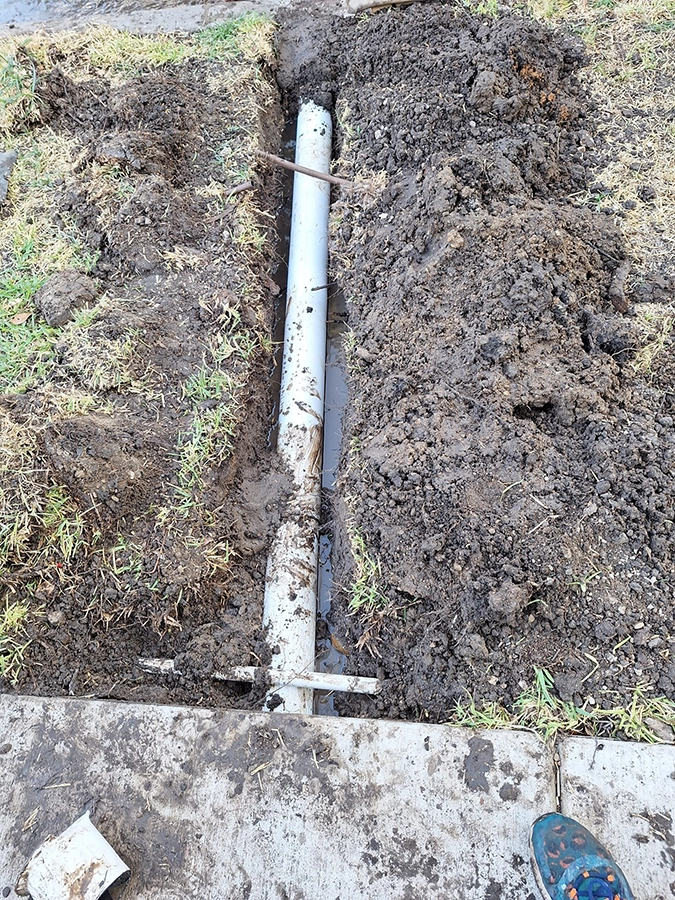
A French drain is a subsurface drainage system. It usually consists of a perforated pipe placed in a sloped trench and surrounded by drainage stone. Filter fabric may also be installed to help prevent surrounding soil from contaminating the stone and pipe.
Water enters through the stone and openings in the pipe before traveling toward a suitable outlet.
French drains are commonly used to address:
- Saturated soil
- Persistently wet sections of a yard
- Subsurface water moving toward a house
- Moisture near retaining walls
- Waterlogged landscape beds
- Groundwater collecting in low areas
- Soil that remains wet after surface puddles disappear
A French drain is not designed to capture a large volume of fast-moving surface runoff through one small opening. It collects water gradually along the length of the trench.
What Is a Surface Drain?
A surface drain captures water that collects or flows above the ground. It generally uses a grated inlet or channel connected to a solid underground pipe.
Common surface-drain components include:
- Catch basins
- Grated yard inlets
- Channel drains
- Trench drains
- Patio drains
- Driveway drains
- Solid underground pipes
Surface drains may be appropriate for:
- Puddles in low areas
- Runoff from patios
- Water crossing walkways
- Driveway drainage
- Pool-deck runoff
- Water collecting near entrances
- Fast-moving stormwater
- Concentrated flow from hard surfaces
Unlike a French drain, a surface system captures water at specific inlet points.
French Drains vs. Surface Drains at a Glance
| Feature | French drain | Surface drain |
|---|---|---|
| Primary purpose | Collects water within saturated soil | Captures water above ground |
| Pipe type | Perforated | Usually solid |
| Water entry | Along the trench | Through a grate or channel |
| Best for | Subsurface moisture and wet soil | Puddles and concentrated runoff |
| Visibility | Mostly concealed by stone or landscaping | Grates remain visible |
| Response | Gradual collection | Faster collection at inlet |
| Common placement | Yards, foundations, retaining walls | Patios, driveways, lawns, entrances |
| Maintenance concern | Sediment entering stone or pipe | Debris blocking grates or catch basins |
Neither system is automatically better. Each one is effective when matched to the correct problem.
When Is a French Drain the Better Choice?
A French drain may be the better option when the main problem is water moving through soil rather than flowing across the surface.
Consider a French drain when:
- The yard stays wet long after rainfall
- Soil near the house remains saturated
- Water moves downhill through the ground
- A retaining wall has recurring moisture
- Landscape beds remain waterlogged
- Surface grading alone cannot redirect the moisture
- The problem extends across a long section of the property
Because the perforated pipe collects water along its length, the trench can intercept subsurface moisture before it reaches a vulnerable area.
When Is a Surface Drain the Better Choice?
A surface drain may be more effective when water gathers rapidly in a visible low spot.
Consider surface drainage when:
- A patio floods during rain
- Water collects on a driveway
- A yard contains a clear low area
- Runoff crosses a walkway
- Water gathers near an entrance
- A downspout discharges into a contained area
- Hard surfaces direct water toward the house
The inlet must be positioned at the actual collection point. If it is installed too high or away from the natural flow path, water may never reach it.
Can a Property Need Both Systems?
Yes. Some drainage problems involve both surface runoff and saturated soil.
For example, a property may need:
- A surface inlet to capture water from a patio
- A solid pipe to transport that runoff
- A French drain to collect moisture from an adjacent lawn
- Gutters and downspouts to control roof water
- An appropriate outlet for the combined drainage plan
The systems may operate alongside each other, but they should not be connected automatically. A contractor must calculate whether the pipe and outlet can manage the combined water volume.
French Drains Should Not Be Confused With Downspout Drains
A downspout drain generally uses solid pipe because it carries concentrated roof runoff. A French drain uses perforated pipe because it is intended to collect water from the surrounding soil.
Connecting a downspout directly to a perforated pipe may release roof water back into the ground before it reaches the outlet. It may also overwhelm a French drain that was not designed for concentrated runoff.
A well-designed gutter and drainage plan may include separate pipes for:
- Roof runoff
- Surface water
- Subsurface moisture
These lines may sometimes share an outlet if the complete system is engineered for the expected volume.
How Gutters Affect Ground Drainage
Before installing French drains or surface drains, the contractor should inspect the roof-drainage system. A wet yard may be caused by overflowing gutters, blocked downspouts, or improperly placed discharge points.
Reliable gutter services in Dallas can identify problems such as:
- Clogged gutter channels
- Incorrect gutter pitch
- Loose hangers
- Leaking corners
- Insufficient downspouts
- Short downspout extensions
- Crushed underground pipes
- Water discharging beside the foundation
Correcting these problems may reduce or eliminate the need for additional yard drainage.
When Is Gutter Repair Necessary?
Professional gutter repair may be needed when water escapes before reaching the downspouts.
Common warning signs include:
- Overflow during moderate rain
- Sagging gutter sections
- Leaking seams or corners
- Gutters pulling away from the fascia
- Standing water inside the channel
- Loose outlets
- Rust, cracks, or holes
- Water stains below the roofline
A gutter repair service should investigate the cause rather than only sealing the visible leak. Repeated leakage may indicate poor pitch, movement, or a blocked downspout.
When Is New Gutter Installation Needed?
New gutter installation in Dallas may be appropriate when the existing system is undersized, badly damaged, or no longer securely attached.
A properly designed system should:
- Match the size and slope of the roof
- Include adequate downspouts
- Maintain the correct pitch
- Remain securely fastened
- Discharge water away from the foundation
- Connect appropriately to ground drainage
A qualified gutter contractor should also determine whether five-inch gutters are adequate or whether the roof design requires a larger system.
Why Gutter Cleaning Matters
Regular gutter cleaning in Dallas helps keep roof runoff from contributing to yard-drainage problems. Leaves, seed pods, twigs, roof granules, and other debris can obstruct both the gutters and downspouts.
Professional cleaning may include:
- Removing debris from gutter channels
- Flushing downspouts
- Inspecting seams and outlets
- Checking for standing water
- Looking for loose fasteners
- Testing underground connections
- Examining discharge areas
Gutters should also be inspected after high winds, hail, or significant storms.
When Is Downspout Repair Required?
Professional downspout repair may be necessary if a downspout:
- Leaks at the joints
- Has crushed or dented sections
- Pulls away from the wall
- Backs up during rain
- Ends too close to the foundation
- Disconnects from underground piping
- Creates erosion beneath the outlet
- Releases water into a low area
An underground blockage may make the visible downspout appear defective. The contractor should inspect both the exposed components and the connected drainpipe.
Installation Considerations for French Drains
A French drain must be designed around the soil and the direction of subsurface water movement.
Important considerations include:
Placement
The trench should intercept water before it reaches the problem area. Installing it where the soil is already lowest may not prevent moisture from moving toward the house.
Slope
The pipe requires enough slope to carry collected water toward its outlet. A level pipe may retain water and sediment.
Pipe Orientation
The perforated pipe must be positioned according to the system design. Incorrect installation may reduce its ability to collect and transport water.
Drainage Stone
Clean drainage stone creates open spaces through which water can travel. Soil-contaminated stone can restrict flow.
Filter Fabric
Properly selected fabric can help reduce soil migration into the stone. Incorrect fabric or poor installation may contribute to clogging.
Outlet
Every French drain needs a suitable destination for collected water. A trench without an effective outlet may simply store water underground.
Installation Considerations for Surface Drains
Surface drains require careful placement and sufficient pipe capacity.
Important considerations include:
Inlet Location
The grate or channel should be installed where water naturally collects or flows.
Elevation
The inlet must be low enough to receive runoff without creating a depression that becomes difficult to maintain.
Pipe Size
The connected solid pipe should be sized for the amount of water expected at the inlet.
Debris Control
Catch basins and grates should limit leaves, mulch, and sediment entering the pipe.
Accessibility
The system should include accessible points for cleaning and inspection.
Safe Discharge
The outlet should not send water toward the building, a neighboring property, or another vulnerable area.
Maintenance Requirements
Both French drains and surface drains require maintenance.
French Drain Maintenance
Maintenance may involve:
- Checking the outlet
- Removing sediment
- Inspecting accessible cleanouts
- Looking for slow drainage
- Preventing soil from entering the stone
- Controlling invasive roots
- Repairing collapsed or separated pipe
Surface Drain Maintenance
Maintenance may include:
- Removing leaves from grates
- Emptying catch basins
- Flushing solid pipes
- Clearing sediment
- Checking channel-drain joints
- Inspecting discharge points
- Replacing damaged grates
A drainage system that cannot be accessed for maintenance may become difficult or expensive to restore after a blockage.
Signs a Drainage System Is Failing
Contact a professional if you notice:
- Water remaining longer than usual
- Drain inlets backing up
- Water emerging near the foundation
- Soggy areas appearing along a pipe route
- Soil sinking above a buried line
- Unpleasant odors from catch basins
- Sediment collecting near outlets
- Water flowing in the wrong direction
- Recurring erosion
- Downspouts backing up during rain
These symptoms may indicate a clog, damaged pipe, insufficient capacity, improper slope, or unsuitable outlet.
Which System Costs More?
Project cost depends on length, depth, excavation conditions, pipe size, surface restoration, and outlet requirements.
French drains may cost more when they require:
- Long or deep trenches
- Large quantities of drainage stone
- Extensive filter fabric
- Excavation through difficult soil
- Landscape restoration
Surface drains may cost more when they require:
- Multiple catch basins
- Long solid-pipe runs
- Concrete cutting
- Channel drains
- Driveway or patio restoration
- High-capacity outlets
The least expensive option is not necessarily the correct one. Installing a drain that does not match the water source can result in additional work later.
How a Professional Determines the Right Solution
Before recommending drainage work, a contractor should evaluate:
- Where the water originates
- Whether it flows above or below ground
- Roof size and runoff volume
- Gutter and downspout performance
- Property slope
- Soil conditions
- Existing underground pipes
- Low areas
- Hard surfaces
- Retaining walls
- Available discharge locations
- Maintenance access
Observing the property during or shortly after rainfall can be particularly useful.
French Drains vs. Surface Drains: Which Is Better?
The answer depends on the problem:
- Choose a French drain for saturated soil and subsurface moisture.
- Choose a surface drain for visible pooling and fast-moving runoff.
- Consider both when the property experiences multiple water sources.
- Correct gutter and downspout problems before installing unnecessary ground drainage.
The best system is the one designed for how water actually moves across and through the property.
Professional Gutter and Drainage Services in Dallas
Choosing between French drains and surface drains requires more than identifying where a puddle appears. The complete property should be evaluated, including the roof, gutters, downspouts, soil, grading, and potential discharge locations.
Emerson Pro Services provides drainage services and gutter services in Dallas, including gutter cleaning, repair, installation, downspout repair, French drains, surface drains, and coordinated gutter and drainage solutions.
Contact Emerson Pro Services to schedule an inspection and determine which drainage system is best suited to your Dallas property.
Emerson Gutters & Drainage is your go-to solution for all your gutter maintenance needs. Located at 550 Greens Pkwy #130, Houston, TX, they are just a call away at 832-220-5386. For a fuss-free installation, visit their website at www.emersonproservices.com to learn more about their services and schedule an appointment online.
Frequently Asked Questions
What is the main difference between French drains and surface drains?
French drains collect water moving through saturated soil. Surface drains capture water pooling or flowing above ground through a grate, channel, or catch basin.
Are French drains better than surface drains?
Neither is universally better. A French drain is generally more suitable for subsurface moisture, while a surface drain is more appropriate for visible runoff and puddles.
Can French drains handle downspout water?
A French drain should not automatically receive concentrated roof runoff. A solid downspout pipe is usually better for transporting roof water, although a contractor may design a coordinated system.
Where should a surface drain be installed?
A surface drain should be placed at the natural low point or directly within the path of runoff. Incorrect placement may prevent water from reaching the inlet.
Do French drains require maintenance?
Yes. French drains may eventually collect sediment or develop root and pipe problems. Outlets and accessible cleanouts should be inspected periodically.
Can gutter problems cause yard flooding?
Yes. Clogged, damaged, or undersized gutters can overflow and concentrate water in the yard. Downspouts may also release water into low areas or beside the foundation.
How do I know whether I need drainage services or gutter repair?
Overflow at the roofline typically suggests a gutter or downspout problem. Water that continues to pool after the roof system drains may indicate grading, surface-drainage, or subsurface-water problems.
Can a property use both French drains and surface drains?
Yes. A property may need surface inlets for fast runoff and a French drain for saturated soil. The pipes and outlet must be designed to accommodate the total water volume.