

A reliable gutter guard can help Fort Worth homeowners manage leaves, twigs, roof granules, and other debris before they create serious blockages. This protection is especially useful in North Texas, where strong winds, seasonal storms, intense heat, and nearby trees can place significant demands on a gutter system.
However, gutter guards are not all built the same. The best option depends on the roof, surrounding vegetation, gutter size, and amount of water the system must handle. Understanding the available designs can help homeowners choose a solution that improves water flow without creating unnecessary maintenance problems.
Why Gutter Guards Matter in Fort Worth
Gutters collect water from the roof and direct it toward the downspouts. When leaves and debris obstruct that path, water may spill over the gutter edge or back up beneath the roofline.
Blocked or poorly maintained gutters can contribute to:
- Water collecting near the foundation
- Soil and landscape erosion
- Stains on siding and masonry
- Damaged fascia and soffits
- Sagging gutter sections
- Overflow near entrances and walkways
- Basement or crawl-space moisture
- Clogged downspouts and underground drains
- Standing water around the property
Professional gutter services can identify whether a gutter guard will improve the existing system or whether cleaning, repairs, or replacement should be completed first.
What Is a Gutter Guard?
A gutter guard is a protective cover or insert designed to reduce the amount of debris entering a gutter. It allows rainwater to reach the gutter channel while blocking or limiting leaves, twigs, pine needles, and other materials.
A properly selected guard may provide several benefits:
- Fewer large clogs
- More consistent water flow
- Reduced debris accumulation
- Easier routine cleaning
- Better protection for downspouts
- Lower risk of gutter overflow
- More manageable long-term maintenance
A gutter guard does not make a system maintenance-free. Dust, seeds, roof granules, and small organic particles can still collect on or beneath the guard. Periodic inspection and gutter cleaning remain necessary.
Best Gutter Guard Options for Texas Homes
Several gutter guard designs are available. Each one has advantages and limitations, particularly when exposed to Fort Worth weather.
1. Micro-Mesh Gutter Guards
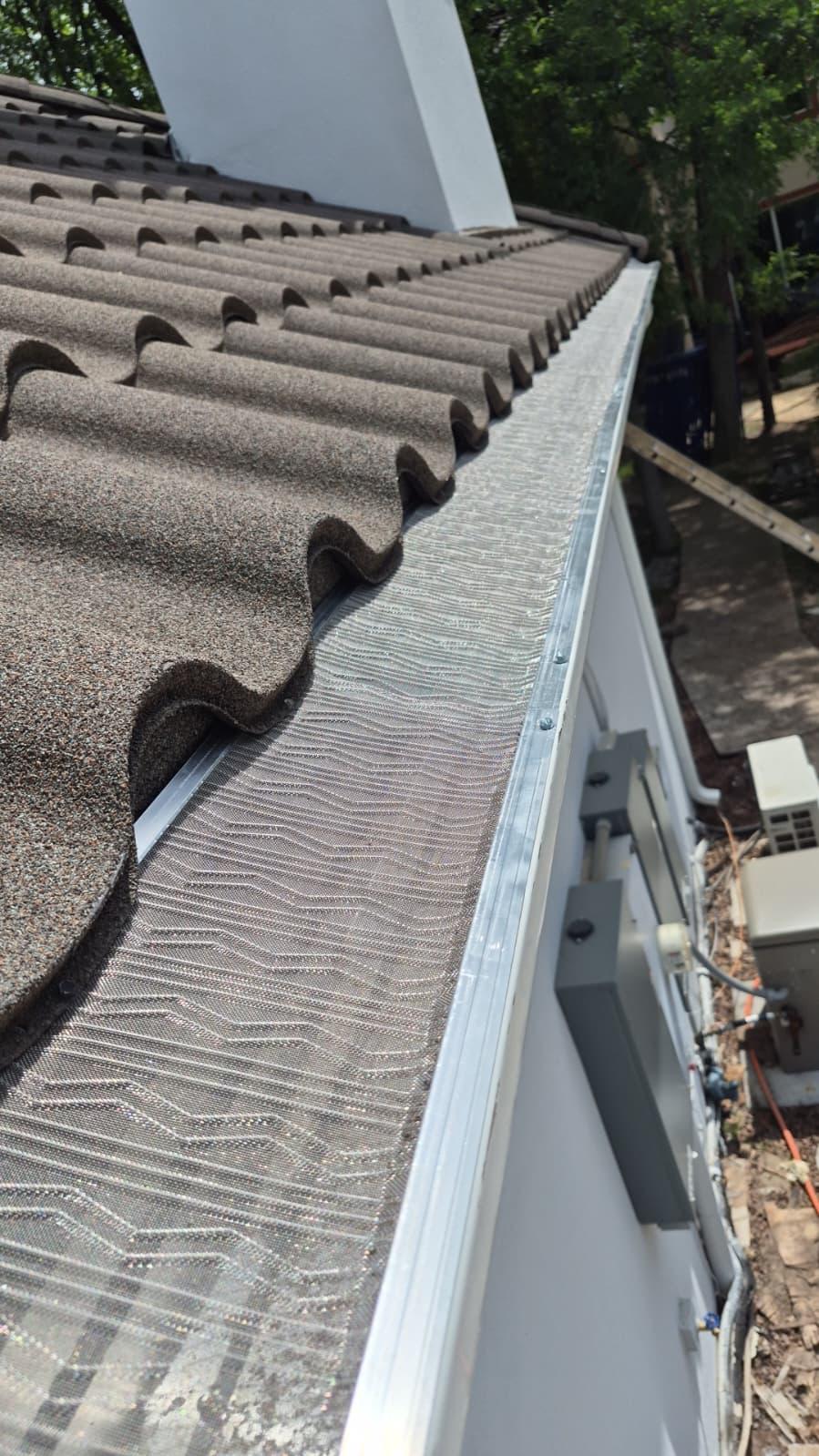
Micro-mesh guards use a fine metal screen to block small debris while allowing water to pass through. They are often manufactured with stainless-steel mesh attached to an aluminum frame.
These guards can be effective against:
- Leaves
- Pine needles
- Twigs
- Seeds
- Shingle granules
- Small airborne debris
Micro-mesh systems are among the most comprehensive options for properties surrounded by different types of trees. Their fine openings can prevent more material from entering the gutter than standard screens.
However, debris may still collect on top of the mesh. If the roof has a steep pitch or carries a large amount of runoff, the guard must be installed at the correct angle and paired with gutters that have enough capacity. Periodic surface cleaning may also be required.
2. Perforated Metal Gutter Guards
Perforated guards are usually made from aluminum or steel panels containing small holes. Water passes through the holes while larger debris remains on the surface.
Potential benefits include:
- Durable construction
- Resistance to warping
- Good airflow around the gutter
- Protection against leaves and twigs
- Compatibility with many gutter systems
- Lower maintenance than open gutters
Metal guards may be a practical choice for Texas heat because they are generally more resistant to temperature-related distortion than lightweight plastic products. The size and spacing of the perforations will affect how well the guard blocks smaller debris.
A professional should confirm that the panels are secured correctly. Loose guard sections may shift during high winds or severe storms.
3. Standard Screen Gutter Guards
Screen guards use larger openings than micro-mesh products. They are typically made from metal or plastic and are placed over the top of the gutter.
Standard screens are generally effective at blocking:
- Large leaves
- Twigs
- Branch fragments
- Larger roof debris
They are often affordable and relatively simple to install. However, pine needles, seeds, and smaller particles may pass through the openings. Leaves can also become caught in the screen and require manual removal.
Screen guards may work well on properties with limited tree coverage, but they may require more attention on heavily wooded lots.
4. Reverse-Curve or Surface-Tension Guards
Reverse-curve guards direct rainwater around a curved edge and into the gutter. Leaves and debris are intended to fall to the ground rather than enter the channel.
These systems can help reduce large debris accumulation, but their performance depends heavily on proper installation. The guard must be positioned correctly relative to the roof edge so that runoff follows the curve.
Possible considerations include:
- Water overshooting during heavy rain
- Debris collecting near the opening
- Visibility from the ground
- Compatibility with the roofline
- Access requirements for future cleaning
Because Fort Worth can experience intense rainfall, the system should be evaluated for water volume rather than selected on appearance alone.
5. Foam Gutter Inserts
Foam inserts fit inside the gutter channel. Their porous structure allows water to pass through while blocking larger debris from filling the gutter.
Foam guards are generally easy to install, but they may not be the best long-term solution for every Texas property. Fine debris can settle inside the material, while trapped moisture and organic matter may require regular cleaning.
Exposure to sunlight and heat can also affect some foam products over time. Homeowners considering this option should review the product’s durability and replacement requirements.
6. Brush Gutter Guards
Brush guards consist of stiff bristles positioned inside the gutter. Leaves and larger debris remain near the top while water flows around the bristles.
They are easy to remove and clean, but smaller particles may become trapped inside the brush. Seeds and organic matter can accumulate between the bristles, particularly on properties with heavy tree coverage.
Brush guards may provide basic protection, but they generally require more hands-on maintenance than a well-installed metal guard system.
Comparing Gutter Guard Types
| Gutter guard type | Best suited for | Main advantage | Maintenance consideration |
|---|---|---|---|
| Micro-mesh | Homes with mixed or small debris | Blocks very small particles | Surface may need cleaning |
| Perforated metal | Hot climates and general debris | Durable and stable | Openings may collect fine debris |
| Standard screen | Homes with larger leaves | Affordable and accessible | Small debris may pass through |
| Reverse curve | Properties with frequent leaf fall | Sheds large debris | Must handle heavy runoff correctly |
| Foam insert | Short-term or basic protection | Easy installation | Can hold fine debris and organic matter |
| Brush guard | Easily accessible gutters | Simple to remove | Debris can become tangled in bristles |
No single guard is automatically best for every home. The correct choice should reflect the roof design, rainfall volume, surrounding trees, and existing gutter condition.
Factors to Consider Before Gutter Guard Installation
Before scheduling gutter installation or adding guards to an existing system, a contractor should evaluate the complete roof-drainage setup.
Important factors include:
Roof Size and Pitch
A large or steep roof can send water toward the gutters quickly. The guard must allow enough water to enter without causing runoff to overshoot the edge.
Gutter Capacity
A guard cannot correct an undersized gutter. If the existing system cannot manage the roof area or expected rainfall, larger gutters or additional downspouts may be necessary.
Surrounding Trees
Broad leaves, pine needles, seed pods, and flowering debris behave differently. The type of vegetation around the property should influence the guard design.
Gutter Condition
Damaged, leaking, or sagging gutters should be repaired before guards are installed. Covering a deteriorated system may hide problems without correcting them.
Roof Material
Guard placement must be compatible with the roofing system. Installation methods that disturb shingles or interfere with roof drainage may create additional concerns.
Downspout Placement
Even clean gutters will overflow if the downspouts are clogged, damaged, or insufficient for the roof area. A contractor should inspect the outlets and confirm that water has a clear discharge route.
Do Gutter Guards Eliminate Gutter Cleaning?
No. Gutter guards can reduce the amount of debris entering the gutter, but they do not eliminate gutter cleaning entirely.
Maintenance may still involve:
- Removing leaves from the guard surface
- Clearing roof granules and sediment
- Flushing the downspouts
- Inspecting corners and outlets
- Checking for loose guard sections
- Looking for leaks or standing water
- Confirming that underground drains accept runoff
The cleaning schedule depends on surrounding trees and weather exposure. Homes with mature trees may need more frequent inspections than properties with open surroundings.
Professional gutter maintenance in Fort Worth should also include checks after hail, high winds, and severe thunderstorms.
Can Gutter Guards Be Added to Seamless Gutters?
Yes, many guard systems can be installed on seamless gutters. Because seamless gutters contain fewer joints along straight runs, they can provide a reliable foundation for a properly fitted guard.
Before installation, the contractor should verify that the seamless gutters:
- Are correctly pitched
- Remain securely attached
- Have adequate capacity
- Do not contain hidden clogs
- Have properly positioned downspouts
- Are free from significant corrosion or damage
If the existing system is in poor condition, replacement may be more practical than installing guards over gutters that will soon require major repairs.
When Are Gutter Repair Services Needed?
Professional gutter repair services may be necessary before or after guard installation when you notice:
- Water leaking from corners or seams
- Gutters pulling away from the fascia
- Loose hangers or fasteners
- Low sections holding water
- Overflow during moderate rainfall
- Rust, cracks, or punctures
- Misaligned gutter sections
- Water escaping behind the gutter
- Damaged downspout connections
Minor problems can become more expensive if guards make the gutter interior difficult to inspect. The system should be cleaned and evaluated before a new guard is installed.
Why Downspout Condition Still Matters
A gutter guard protects the horizontal channel, but it cannot compensate for a blocked or damaged downspout. Downspouts must carry collected water to ground level and release it away from the building.
Downspout repair may be needed when:
- Water leaks from the joints
- Sections are crushed or disconnected
- Fasteners have pulled away
- Water backs up into the gutters
- The outlet causes erosion
- Underground pipes are clogged
- Water pools beside the foundation
Downspout extensions or underground piping may also be needed to move water farther from the structure.
Gutter Guards and Complete Drainage Solutions
Gutter guards address debris at the roofline, but they are only one part of a complete water-management plan. Once water reaches the ground, it must continue moving away from the foundation.
Professional drainage solutions may include:
- Downspout extensions
- Underground solid drainpipes
- Catch basins
- Channel drains
- Surface grading
- Dry wells where appropriate
- French drain systems
French drains are designed to collect water moving through saturated soil. They do not replace gutters or downspouts, but they may help address persistent groundwater or yard-drainage problems.
A property may need both gutter improvements and ground-level drainage corrections. Installing a premium guard will not solve standing water caused by poor grading or a blocked underground pipe.
How to Choose the Right Gutter Guard
A professional evaluation can help determine which guard offers the right balance of debris protection, water capacity, durability, and maintenance.
Before choosing a product, ask:
- What type of debris affects the property?
- Can the system manage intense rainfall?
- Is the material suitable for Texas heat?
- Will the guard remain secure during high winds?
- How will the gutter be inspected and cleaned?
- Does installation affect the roof?
- Is the product compatible with the existing gutters?
- What maintenance does the manufacturer recommend?
- Are the downspouts large enough for the system?
Avoid choosing a guard based only on price or advertising claims. The product must work with the home’s actual roof and drainage conditions.
Professional Gutter Services in Fort Worth
The right gutter guard can reduce clogs and make routine maintenance more manageable, but performance depends on correct product selection and installation. Gutters, guards, downspouts, and ground-level drainage should operate as one coordinated system.
Emerson Pro Services provides gutter inspections, gutter cleaning, gutter repair services, seamless gutter solutions, downspout repair, and drainage improvements for homeowners in Fort Worth, Texas.
Contact Emerson Pro Services to schedule an inspection and determine which gutter guard option is best suited to your roof, surrounding trees, and drainage needs.
Frequently Asked Questions
What is the best gutter guard for Texas weather?
Micro-mesh and perforated metal guards are often strong candidates because they can block debris while resisting heat and weather exposure. The best option depends on the roof pitch, gutter size, nearby trees, and expected water volume.
Do gutter guards work during heavy rain?
A properly selected and installed guard should allow substantial water flow, but performance varies by design. An undersized gutter, steep roof, clogged guard, or insufficient downspout capacity may still cause overflow.
Do gutter guards prevent all clogs?
No. They reduce debris but cannot prevent every clog. Fine sediment, roof granules, seeds, and organic particles may still accumulate over time.
How often should guarded gutters be cleaned?
The schedule depends on surrounding vegetation and weather conditions. Many homes benefit from at least annual inspections, while tree-covered properties may require more frequent service.
Can gutter guards be installed on old gutters?
Yes, if the gutters remain structurally sound and properly pitched. Leaks, sagging sections, loose fasteners, and drainage problems should be corrected before installation.
Are gutter guards compatible with seamless gutters?
Many gutter guards are compatible with seamless gutters. A contractor should measure the system and choose a guard that fits securely without interfering with the roof.
Will gutter guards solve foundation drainage problems?
Not by themselves. Guards may improve roof-water collection, but downspouts and ground-level drainage must carry that water away. French drains, grading, or underground drainage solutions may also be required.