


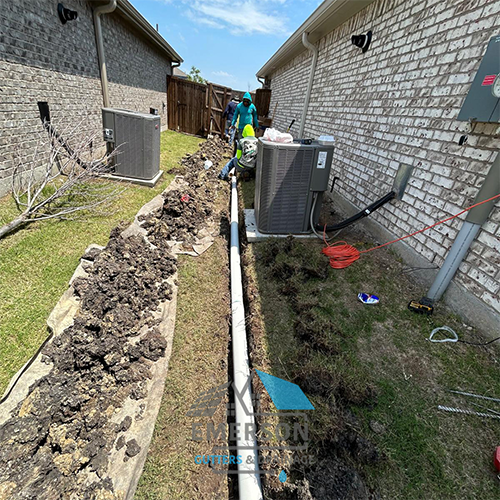
A downspout drain is an underground pipe that carries concentrated rainwater from a roof gutter system to an appropriate discharge area away from the house. It connects to a downspout at ground level and transports the runoff beneath the yard instead of releasing it beside the foundation.
For Garland homeowners, an underground downspout drain can provide a practical way to manage heavy roof runoff while avoiding long above-ground extensions. However, the system must be correctly sized, sloped, connected, and maintained. A poorly designed or clogged drain may cause water to back up, overflow from the gutters, or collect near the home.
Understanding how underground downspout drains work can help homeowners decide whether this solution belongs in their complete gutter and drainage plan.
How Does an Underground Downspout Drain Work?
The gutter collects rainfall from the roof and moves it toward a downspout. The downspout carries the water vertically to ground level, where it connects to a buried pipe.
The underground pipe then uses gravity to transport the roof runoff toward an appropriate outlet.
A typical system may include:
- Roof gutters
- Downspouts
- Downspout adapters
- Catch basins where appropriate
- Solid underground drainage pipes
- Fittings and cleanouts
- Pop-up emitters or other approved outlets
- Erosion protection at the discharge area
Every component must work properly. A clean underground pipe cannot compensate for undersized or clogged gutters, and functional gutters cannot protect the property if the buried pipe is blocked or damaged.
Why Move Downspout Water Underground?
A downspout that ends directly beside the house may release a large amount of concentrated water into one small area. During heavy rain, that runoff can saturate the soil and wash away landscaping.
An underground downspout drain can help:
- Move roof runoff farther from the foundation
- Reduce erosion beneath downspouts
- Prevent long extensions from crossing the lawn
- Keep walkways more accessible
- Reduce puddles near exterior walls
- Protect landscape beds from concentrated discharge
- Create a cleaner-looking exterior
- Connect roof drainage to a planned outlet
The system does not eliminate water; it redirects it. The discharge location must be capable of receiving the runoff without creating another drainage problem.
Downspout Drain vs. Downspout Extension
A downspout extension is an above-ground component that moves water away from the base of the downspout. It may be rigid, hinged, roll-out, or flexible.
An underground drain performs the same general function but carries the water beneath the ground.
| Feature | Downspout extension | Underground downspout drain |
|---|---|---|
| Location | Above ground | Below ground |
| Visibility | Usually visible | Mostly concealed |
| Access | Easy to inspect | More difficult to inspect |
| Installation | Generally simpler | Requires excavation and planning |
| Lawn use | May obstruct mowing or walking | Keeps the surface clearer |
| Maintenance | Easy to reposition or clean | May require cleanouts or specialized service |
| Damage risks | Mowers, foot traffic and displacement | Roots, sediment, collapse and underground movement |
| Best use | Short, accessible discharge route | Longer or concealed drainage route |
A downspout extension may be enough when water can be released safely a short distance from the house. An underground system may be more practical when an extension would cross a walkway, interfere with landscaping, or fail to carry runoff far enough away.
Downspout Drain vs. French Drain
An underground downspout drain and a French drain are not the same system.
A downspout drain normally uses a solid pipe because it transports concentrated roof runoff from one point to another. The goal is to keep the collected water inside the pipe until it reaches the outlet.
A French drain generally uses a perforated pipe surrounded by drainage stone. Its purpose is to collect water from saturated soil along the trench.
| System | Primary purpose | Typical pipe |
|---|---|---|
| Downspout drain | Transports concentrated roof runoff | Solid pipe |
| French drain | Collects subsurface moisture | Perforated pipe |
| Surface drain | Captures water pooling above ground | Grated inlet with solid outlet pipe |
| Gutter system | Collects rain from the roof | Open gutter and enclosed downspout |
Connecting a downspout directly to a perforated French-drain pipe may release concentrated roof water into already saturated soil. Whether systems can share a discharge route depends on the design, expected water volume, pipe capacity, and site conditions.
Downspout Drains vs. Surface Drains
Surface drains collect water that flows or pools above ground. They often use a grated catch basin, yard inlet, or channel drain connected to an underground pipe.
A downspout drain receives water directly from the roof drainage system, while a surface drain collects runoff from:
- Low lawn areas
- Patios
- Walkways
- Driveways
- Pool decks
- Landscape beds
- Courtyards
Some properties use both. For example, a catch basin may collect yard runoff near a downspout while a connected solid pipe transports the combined flow away. The system must be sized for the total expected volume.
Common Components of a Downspout Drainage System
Downspout Adapter
The adapter connects the visible downspout to the underground pipe. A poor connection may leak, separate, or allow debris into the system.
Catch Basin
A catch basin may accept water from a downspout and the surrounding ground surface. It can collect limited sediment before water enters the pipe, but it requires periodic cleaning.
Solid Drainage Pipe
Solid pipe carries the water without intentionally releasing it into the surrounding soil. Pipe material, diameter, strength, and connection type should match the installation conditions.
Cleanout
A cleanout creates an accessible point for inspecting or servicing the line. Properly positioned access can make future maintenance easier.
Outlet
The outlet releases water at the end of the system. Possible outlets depend on the site and applicable requirements.
An outlet may use:
- A daylight opening
- A pop-up emitter
- An approved drainage area
- Another properly designed discharge method
The outlet should remain visible or accessible enough for inspection.
Where Should a Downspout Drain Release Water?
An effective drainage system must have a safe destination for the water. The outlet should not simply move roof runoff from one problem area to another.
The discharge location should avoid:
- Directing water back toward the house
- Creating erosion
- Flooding walkways or patios
- Damaging neighboring property
- Blocking pedestrian areas
- Remaining buried under soil or mulch
- Creating standing water
- Interfering with utilities
- Violating applicable drainage requirements
Property slope, soil, landscaping, available space, and local requirements all influence the best outlet location.
Why Underground Downspout Drains Become Clogged
A buried downspout drain can clog even when the visible pipe appears undamaged.
Common causes include:
- Leaves
- Twigs
- Roof granules
- Seed pods
- Animal nests
- Soil
- Mulch
- Root intrusion
- Pipe settlement
- Collapsed pipe sections
- Separated fittings
- A blocked outlet
- Insufficient slope
- Standing water that allows sediment to accumulate
Debris often begins in the gutters. When the channels are not maintained, leaves and roof particles travel into the downspouts and underground pipes.
Regular gutter cleaning is therefore an important part of protecting the buried drainage system.
Signs of a Clogged Downspout Drain
Watch for these warning signs:
- Water spills from the underground connection
- Gutters overflow despite being cleaned
- Water backs up into a catch basin
- Little or no water exits at the outlet
- The surrounding soil remains unusually wet
- Water collects beside the foundation
- Gurgling or bubbling occurs during rain
- The connection separates under pressure
- Water emerges from the ground along the pipe route
- A pop-up emitter does not open
- The outlet remains dry during heavy rain
A complete inspection should include the gutters, downspout, underground pipe, and outlet. The blockage may be located far from the visible overflow.
How Gutter Cleaning Protects Underground Drains
Professional gutter cleaning reduces the amount of debris entering the downspouts. Cleaning should address more than the open gutter channels.
A complete service may include:
- Removing leaves and organic material
- Clearing roof granules from low areas
- Cleaning downspout outlets
- Flushing visible downspouts
- Checking underground connections
- Inspecting gutter pitch
- Looking for sagging or standing water
- Confirming that runoff reaches the discharge point
Gutter guards may reduce larger debris, but they do not make the system maintenance-free. Smaller particles and organic material can still collect in the gutters or underground lines.
Common Downspout Drain Installation Mistakes
Incorrect installation can cause recurring backups even when the pipe is relatively new.
Common problems include:
- Using an undersized pipe
- Installing insufficient slope
- Creating low sections that hold water
- Using weak pipe where loads may crush it
- Leaving loose or poorly sealed connections
- Including unnecessary sharp turns
- Connecting too many downspouts to one line
- Failing to provide service access
- Burying the outlet
- Using perforated pipe where solid pipe is needed
- Discharging water into a low area
- Failing to consider tree roots
- Installing without checking utilities
Professional installation should account for the roof area, expected rainfall, route length, pipe capacity, soil, surface loads, and discharge location.
The Importance of Pipe Slope
Most downspout drains depend on gravity. The pipe needs a consistent slope toward the outlet.
If the line contains low areas, water and sediment may remain inside it. Over time, the buildup may reduce capacity and contribute to clogs.
Problems associated with incorrect slope include:
- Slow drainage
- Standing water
- Organic buildup
- Sediment accumulation
- Unpleasant odors
- Insect activity
- Recurring backups
- Increased pressure at connections
The required slope depends on the pipe, design, flow, and site conditions. A drainage professional should establish the route rather than relying on the yard’s appearance alone.
How Many Downspouts Can Connect to One Pipe?
Several downspouts may be connected to a shared underground line, but the pipe must be sized for the combined runoff.
Important considerations include:
- Roof area draining to each downspout
- Roof pitch
- Expected rainfall intensity
- Pipe diameter
- Pipe slope
- Number of fittings
- Distance to the outlet
- Additional surface-drain connections
- Outlet capacity
Adding another downspout to an existing pipe without evaluating capacity can cause backups during heavy rain.
Can Surface Drains Share the Same Pipe?
In some designs, surface drains and downspouts may connect to a shared solid pipe. However, combining them increases the amount of water and debris entering the line.
Before connecting the systems, a contractor should evaluate:
- Total expected flow
- Pipe capacity
- Catch-basin placement
- Sediment control
- Pipe slope
- Outlet capacity
- Risk of backup
- Maintenance access
A shared system should not allow downspout water to rise through a yard drain near the foundation during heavy rainfall.
Signs the Drain Pipe May Be Damaged
Not every backup is caused by loose debris. The pipe itself may be damaged.
Possible warning signs include:
- Repeated clogs in the same location
- Sinking soil above the pipe
- Water emerging from the ground
- Roots found during cleaning
- Sections that will not accept inspection equipment
- Unexplained wet areas along the route
- Reduced flow after previous cleaning
- A crushed or separated outlet
- Visible pipe movement
- Drain performance that worsens over time
Professional repair may require locating the affected area, excavating it, and replacing the damaged section.
Downspout Drain Repair vs. Replacement
The appropriate solution depends on the cause and extent of the failure.
| Condition | Possible approach |
|---|---|
| Minor debris blockage | Professional cleaning |
| Blocked outlet | Clear and restore outlet |
| Loose adapter | Reconnect or replace fitting |
| One damaged pipe section | Local excavation and repair |
| Root intrusion in a limited area | Remove roots and repair pipe |
| Incorrect slope in one section | Regrade and reinstall section |
| Widespread pipe collapse | Replace the line |
| Undersized system | Redesign and replace |
| No suitable discharge | Develop a new drainage plan |
| Repeated failure after repairs | Evaluate full replacement |
Professional gutter repair in Garland may also be needed if overflowing water has loosened gutters, damaged outlets, or altered the gutter pitch.
When Gutter Repair Is Part of the Solution
An underground drain cannot work correctly if the roofline system fails to deliver water into it.
Professional gutter repair services may be required when:
- Gutters sag
- Hangers are loose
- Seams leak
- End caps fail
- Outlets are damaged
- The gutter slope is incorrect
- Downspouts are detached
- Water flows behind the gutter
- The system is undersized
A contractor should examine the complete gutter and drainage route—from the roof edge to the final discharge point.
When New Gutter Installation Is Needed
New gutter installation may be appropriate when the existing system is severely corroded, repeatedly leaking, improperly sized, or damaged in several areas.
A replacement project should coordinate:
- Gutter dimensions
- Downspout number
- Downspout placement
- Underground pipe locations
- Roof valleys
- Expected water volume
- Drainage outlets
- Maintenance access
Installing new gutters without evaluating existing underground lines can create backups if the improved roof system sends more water into damaged or undersized pipes.
How an Underground Downspout Drain Is Installed
The specific process varies by property, but installation may involve:
- Inspecting the existing gutters and downspouts
- Identifying an appropriate outlet
- Planning the pipe route
- Checking for underground utilities
- Determining the necessary pipe size
- Establishing the required slope
- Excavating a trench
- Preparing a stable pipe base
- Installing solid drainage pipe
- Connecting fittings and cleanouts
- Testing water flow
- Backfilling the trench
- Restoring soil, grass, or landscaping
- Inspecting the outlet for erosion
Installation should be planned before excavation begins. A trench without an effective outlet will not solve the drainage problem.
Does Every Home Need an Underground Downspout Drain?
No. Some properties can manage roof runoff effectively with properly positioned above-ground extensions and suitable grading.
An underground drain may be beneficial when:
- A short extension cannot move water far enough
- Water collects near the foundation
- Extensions cross walkways
- Landscaping restricts above-ground discharge
- Roof runoff causes erosion
- The property needs a cleaner surface layout
- Several downspouts require coordinated drainage
- A suitable underground route and outlet are available
The decision should be based on actual water movement and site conditions.
Underground Downspout Drain Maintenance
A buried system should be inspected regularly even though most of it is out of sight.
Maintenance may include:
- Cleaning gutters
- Flushing downspouts
- Removing catch-basin sediment
- Checking adapters
- Clearing exposed outlets
- Keeping pop-up emitters free
- Removing mulch from drain openings
- Monitoring wet areas above the pipe
- Checking for soil settlement
- Inspecting after severe storms
- Addressing slow drainage promptly
- Keeping roots and heavy loads away from vulnerable lines
Avoid waiting for complete blockage. Slow flow and minor backups can be early signs of developing problems.
Why DIY Downspout Drain Installation Can Fail
An underground line may appear simple, but effective drainage requires careful planning.
DIY systems commonly fail because of:
- Incorrect pipe selection
- Inadequate slope
- Undersized pipe
- Too many sharp turns
- Weak connections
- No cleanout
- Poor trench preparation
- A buried outlet
- Improper discharge
- Utility conflicts
- Pipe crushing
- Combining incompatible systems
Professional gutter services can evaluate whether the roofline system, buried pipe, and discharge route are compatible.
Choosing a Gutter and Drainage Contractor in Garland
Before approving a project, ask the contractor to explain:
- Where the water originates
- Why an underground drain is recommended
- What pipe will be used
- How the line will be sloped
- How many downspouts will connect
- Where the water will discharge
- Whether surface drains will be included
- How the pipe can be maintained
- How landscaping will be restored
- Whether gutter cleaning or repair is also needed
A complete proposal should address the source, transport route, and outlet—not merely the location where water is currently visible.
Underground Downspout Drain Services in Garland
A properly planned downspout drain can move concentrated roof runoff away from the home while keeping extensions and drainage pipes out of the main yard surface. Its performance depends on clean gutters, functional downspouts, adequate pipe capacity, consistent slope, durable connections, and a safe outlet.
Emerson Pro Services provides gutter services and drainage solutions in Garland, including gutter cleaning, gutter repair, gutter installation, downspout extensions, underground downspout drains, surface drains, and related drainage-system improvements.
Whether your existing underground pipe is clogged, damaged, undersized, or improperly routed, Emerson Pro Services can inspect the complete gutter and drainage system and recommend an appropriate solution.
Contact Emerson Pro Services to schedule a gutter and drainage inspection for your property in Garland.
For gutter guards, gutter inspections, gutter cleaning, repairs, or residential and commercial gutter installations in Garland, Texas contact Emerson Pro Services. Visit emersonproservices.com or call
(214) 972-0811 to discuss your property’s gutter and drainage needs.
Frequently Asked Questions
What is an underground downspout drain?
It is a buried pipe that connects to a roof downspout and carries concentrated rainwater to an appropriate discharge area away from the house.
Should a downspout drain use solid or perforated pipe?
A dedicated downspout drain generally uses solid pipe to transport roof runoff without releasing it into the surrounding soil. Perforated pipe is normally associated with systems that collect subsurface water.
What is the difference between a downspout drain and a French drain?
A downspout drain carries roof runoff through a solid pipe. A French drain collects water from saturated soil through a perforated pipe surrounded by drainage stone.
Why is water backing up from my underground downspout drain?
Possible causes include leaves, roof granules, roots, pipe collapse, separated fittings, inadequate slope, insufficient capacity, or a blocked outlet.
Can several downspouts connect to one underground pipe?
Yes, if the pipe, slope, fittings, and outlet are designed to handle the combined runoff. An undersized shared line may back up during heavy rain.
Do underground downspout drains require maintenance?
Yes. Gutters, downspouts, adapters, catch basins, cleanouts, pipes, and outlets should be inspected and maintained to prevent blockages.
Can surface drains connect to a downspout-drain pipe?
They may share a solid drainage line in a properly designed system. The pipe and outlet must have enough capacity for both roof runoff and surface water.
Is an underground drain better than a downspout extension?
Neither option is always better. An extension is simpler and easier to inspect, while an underground drain can move water farther without obstructing the yard. The best choice depends on the property.